
The speedometer that keeps the drive.
Live GPS speed on a gauge you can read at a glance. When you park, the drive becomes a replayable route with G-force, corner grades and a driving score, computed on your iPhone.
No account. First drive free.iPhone, iOS 17 or later. Available in 11 languages. Designed for passive recording: start it, then leave the phone alone.
Most speedometer apps show a number and forget it. Torq keeps every drive.
The live reading is the easy part. What Torq adds is the record: the route, the speed at every point on it, each corner, each hard stop, and a score you can watch move from one week to the next.
Start it once. Read it after.
Torq is built for passive recording. Nothing in it needs a tap while the car is moving.
Mount the phone and press Start
A dashboard or vent mount keeps the motion sensors steady. Torq asks for location and motion permission once, then a single button starts the recording.
Drive. Do not touch the phone.
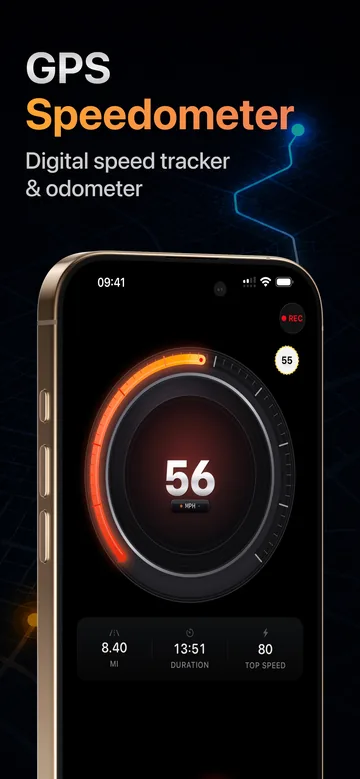
The gauge shows current speed with the posted limit beside it. Distance, time, average and top speed update live, and the speed stays visible on the Lock Screen if you switch to Maps.
Stop, and read the scorecard
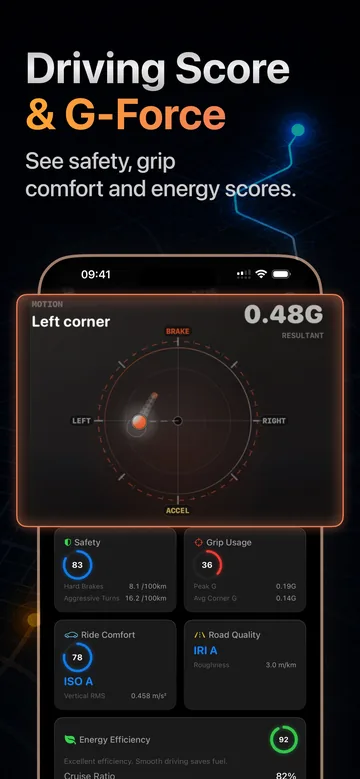
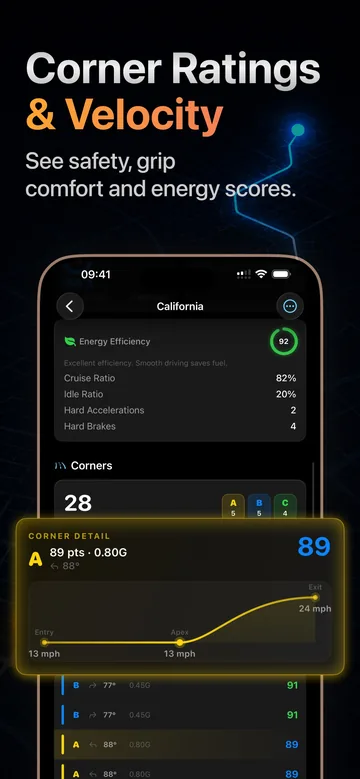
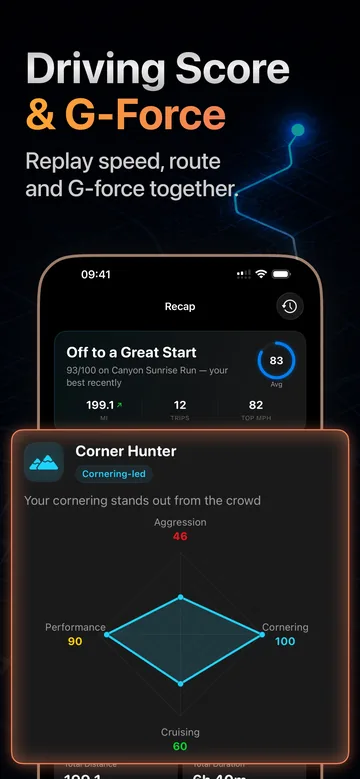
Torq turns the GPS trace and the motion data into a driving score, a safety grade, a comfort grade, a road-quality grade and a list of every corner with its rating.
Replay it, or take the data out
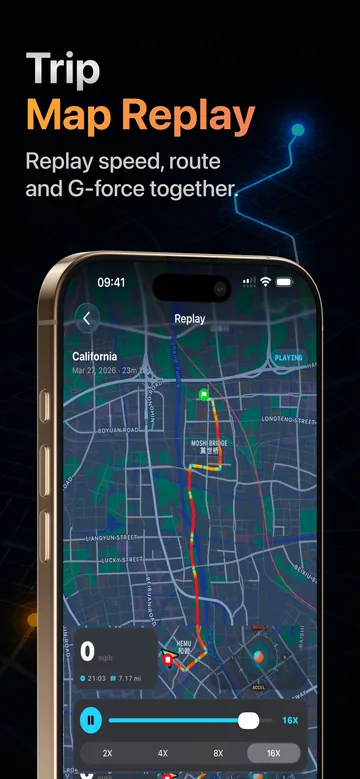
The route replays as a speed heat map at up to 16x. Export the drive as a GPX track, a CSV summary or the raw sensor file whenever you want it somewhere else.
A gauge, the limit, and the trip so far.
Current speed on a large dial with the posted limit in a sign beside it. Under the gauge: distance, duration, average and top speed, and altitude.
- Speed stays visible outside the app: on the Lock Screen, in the Dynamic Island, and as a floating Picture in Picture window over Maps or music.
- An optional alert when you pass the limit of the road you are on, with a manual limit for roads the map data does not cover.
- Two GPS modes, Balanced or High, to trade battery for sample quality.
- Pause and resume by hand. Torq never auto-pauses a drive it cannot see the end of.
The route, colored by how fast you were going.
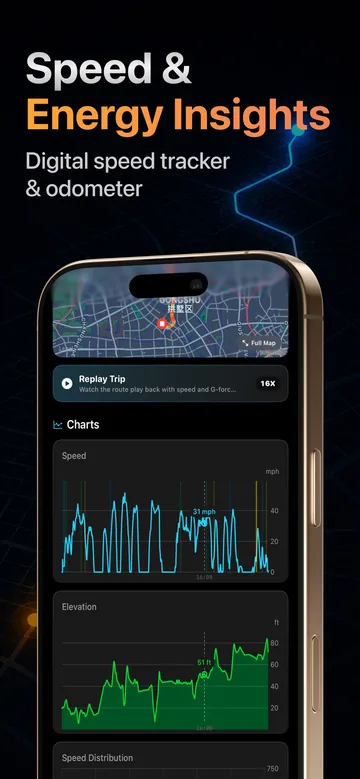
Every drive is saved as a route you can replay at 2x, 4x, 8x or 16x. The line is a speed heat map, blue where you were slow and red where you were fastest, and it can be recolored by road quality, G-force or elevation.
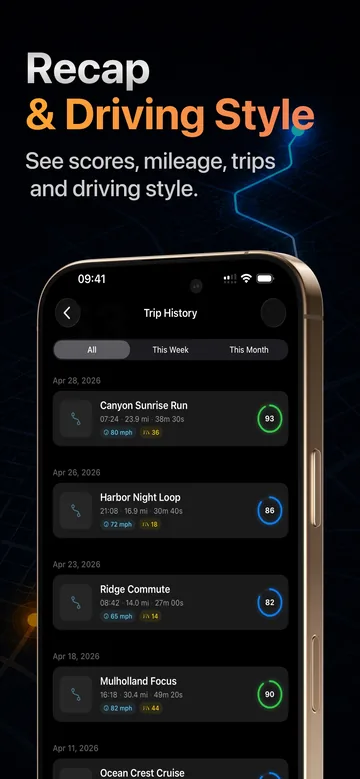
Below the map: a speed chart, an elevation chart, a speed distribution, and the list of corners with their ratings. Scrub the chart and the marker moves on the map. The trip history keeps every drive with its score, distance and top speed, filterable by week or month.
A driving score with its working shown.
Smoothness, cornering, speed control and efficiency combine into one number. Safety, ride comfort and road quality get their own grades. After four scored trips, a driving style profile appears.
Each component is a published formula, not a black box: smoothness is the 90th percentile of jerk, comfort is the ISO 2631 vertical vibration scale, road roughness is an IRI-style index. The page on the score explains every one and what moves it.
Seven screens from the App Store listing.
The gauge, the friction circle, the charts, a corner, the replay, the style card and the history.
Research-informed, not a scoreboard
Torq filters GPS speed with a robust local outlier detector and a physical plausibility gate before anything is scored, so a satellite glitch cannot become your top speed. The comfort and road grades use the ISO 2631 and IRI scales that road engineers use.
Built for real roads
Turn detection starts at 25 degrees of heading change, corners at 22, a brake event at 3.5 m/s² of deceleration. Tunnels and overpasses are detected from the GPS dropout so a lost signal is marked, not scored.
Your drives stay yours
Trips live in a database on the phone. Torq has no login and no cloud copy. Analytics, crash reports and subscription status go to named providers; your route does not, unless you export it.
Free to try. Pro for every drive after.
The first drive records and analyzes free, with no account. Recording every drive after that needs Torq Pro. No account is created at any point.
Pro is an auto-renewable subscription billed through the App Store, offered weekly, monthly, quarterly or yearly. Prices and any trial are shown in the app before purchase and vary by region. Cancel any time in your Apple Account settings; the current period runs to its end.
With Torq Pro
- Unlimited drive analysis and score history
- G-force, braking and cornering breakdowns
- Live Activity and PiP performance overlays
- Advanced recap trends across every trip
- Raw drive data export for deeper review
Questions people ask
Is Torq a free GPS speedometer?
Torq is free to download and needs no account. The first drive records and analyzes free, with no account. Recording every drive after that needs Torq Pro. Torq Pro is an auto-renewable subscription offered weekly, monthly, quarterly or yearly; the plans, prices and any trial are shown in the app before you buy, and they vary by country.
How accurate is the GPS speed compared to my car's speedometer?
Usually more accurate. Car speedometers are built to read a little high and drift with tire size, so a GPS reading a few units under the dial is the GPS being right. Under open sky, one-second GPS speed is typically within one or two km/h of true speed. In tunnels, parking garages and between tall buildings the signal degrades, and Torq filters the spikes rather than reporting them as a top speed.
Does it work in mph and km/h?
Yes. The unit system is a setting: imperial gives mph and miles, metric gives km/h and kilometers, and it changes the speedometer, the trip stats, the charts and the exports together.
Can I see my speed while using Maps or music?
Yes. While a drive is recording, the speed appears in a Live Activity on the Lock Screen and in the Dynamic Island, and a Picture in Picture window can float over any other app with the current speed. Both are settings you turn on once.
Does Torq need an internet connection?
Recording, the speedometer, the scorecard and the replay all run on the phone with no connection. The one feature that talks to a server is the speed-limit lookup, which asks OpenStreetMap for the posted limit of the road you are on; without a connection the limit shows as unknown and everything else continues.
Does it record in the background?
Yes. Once a drive is started, recording continues with the screen off or another app in front. The Live Activity shows it is still running, and the status bar carries the location indicator iOS shows for any app using location in the background.
Does Torq work on a motorcycle, a bicycle or a boat?
The speedometer, distance, duration and the route replay come from GPS and work in any vehicle. The cornering, G-force and driving-score analysis is calibrated for a car with the phone in a mount; on a bike or a boat those grades will not mean what they mean in a car, so treat them as a curiosity rather than a measurement.
What happens to my trips? Are they uploaded?
Trips are stored in a database on your iPhone and analyzed there. Torq has no account and no server-side copy of your drives. A trip leaves the phone only when you export or share it. The app does send anonymous analytics, crash reports and purchase status to its service providers; the privacy policy lists each one.
Make the next drive measurable.
Install Torq, mount the phone, press Start. The first drive is free, the analysis runs on the phone, and the file is yours to export.
iPhone, iOS 17 or later. No account. First drive free.